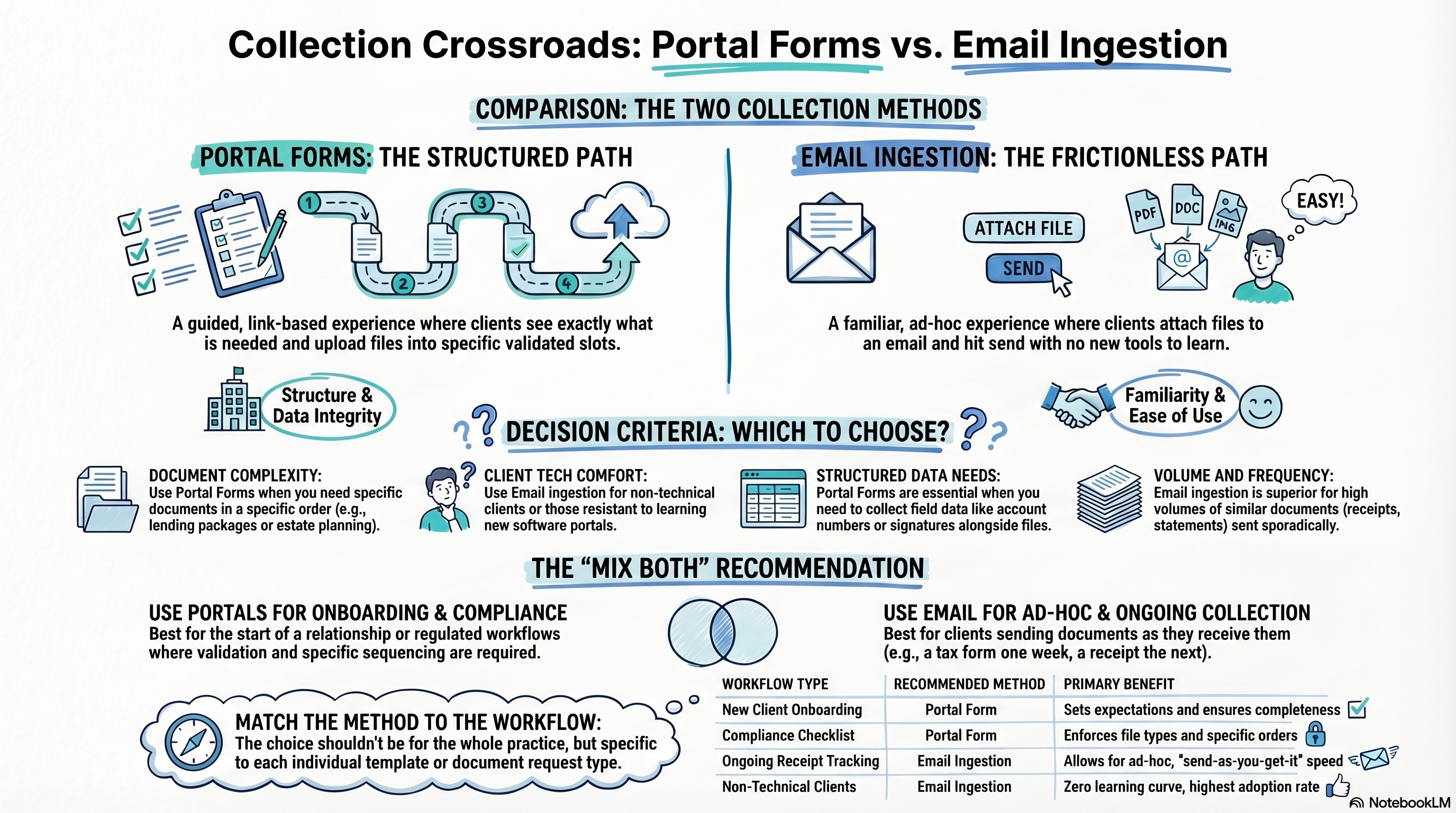
Most advisors start with portal forms for structured intake (onboarding, compliance, annual reviews) and add email ingestion for clients who prefer email or for ad-hoc document collection. If you're unsure, start with whichever method matches how your clients already send you documents — you can always add the other later.
Connecting...
Email Ingestion or Portal Forms?
FolioReady gives you two ways to collect documents from clients: portal forms, where clients open a link and upload files into a structured form, and email ingestion, where clients send an email with attachments to a dedicated address. Both work. The question is which one fits the way your clients actually operate — and the answer might be different for different parts of your practice.
Why This Choice Matters
The method you choose shapes the client experience
A portal form is structured and guided. The client sees exactly what's needed, uploads files into specific slots, and fills in any required fields before submitting. It's a controlled experience — great for complex workflows, but it requires the client to learn something new.
Email is unstructured and familiar. The client composes a message, attaches files, and hits send. There's nothing to learn, nothing to navigate. But you're trusting the client to send the right things, and there's no validation before it lands in your inbox.
Neither approach is universally better. It depends on what you're collecting, who you're collecting it from, and how much structure the workflow actually needs.
You can use both
This isn't an either/or decision for your entire practice. Each template in FolioReady can use a different collection method. You might use portal forms for structured onboarding — where you need specific documents in a specific order — and email ingestion for ad-hoc document collection, where clients send things as they have them.
Think of it as choosing the right tool for each workflow, not picking a single approach for everything.
When Portal Forms Work Best
You need specific documents in a specific order
Compliance-heavy workflows — client onboarding for regulated industries, lending document packages, estate planning checklists — often require particular documents in a particular sequence. Portal forms let you define exactly what's needed, label each upload slot, and ensure nothing is missing before the client submits.
You want validation before submission
Portal forms can require fields, enforce file types, and prevent incomplete submissions. If getting the wrong document or a missing signature means starting over, the upfront validation saves everyone time.
You're collecting structured data alongside files
When you need the client to fill in fields — contact information, account numbers, signatures, answers to questions — alongside their file uploads, a portal form keeps everything in one place. Email ingestion only captures attachments and basic sender information.
The client relationship is new
For clients who haven't worked with you before, a guided portal form sets expectations. They see what's needed, understand the process, and feel confident they're doing it right. An email address with no context can feel vague — "What exactly should I send?"
When Email Ingestion Works Best
Clients are non-technical or resistant to new tools
Some clients will happily email you a document but won't click a portal link. They're not being difficult — they just have a workflow that works for them, and asking them to change it creates friction that delays the documents you need. Email ingestion meets them where they are.
Documents are ad-hoc
Not every document collection workflow is structured. Sometimes clients send things as they get them — a bank statement this week, a tax form next week, a receipt when they find it. Email ingestion handles this naturally. Each email creates a folio, and you review them as they arrive.
You're replacing an existing email-based workflow
If your current process is "clients email me their documents and I download and organize them manually," email ingestion is the direct upgrade. The client's experience doesn't change at all — they send an email to an address. But now FolioReady catches it, creates the folio, stores the files, and runs AI extraction if you've set it up.
Volume matters more than structure
When you're collecting high volumes of similar documents — receipts, statements, certificates, invoices — the overhead of a portal form for each one doesn't make sense. Email ingestion lets clients batch-send documents quickly, and you process them in bulk.
Mixing Both Approaches
Most practices benefit from using both methods across different templates. Here's how that typically looks:
Structured onboarding → portal form. When a new client comes on board, you need specific documents, signed agreements, and filled-in fields. A portal form ensures nothing is missed and the client knows exactly what to do.
Ongoing document collection → email ingestion. Once the client relationship is established, the back-and-forth is looser. Clients send documents as they have them — annual statements, updated identification, new financial records. An email address is simpler than sending a new portal link every time.
Compliance workflows → portal form. Anything with regulatory requirements benefits from the structure and validation a portal form provides. You have an auditable record of what was requested and what was received.
Ad-hoc requests → email ingestion. When you just need a client to send you a document and don't want to set up a full form for it, email ingestion keeps things lightweight.
The key is matching the method to the workflow, not the client. The same client might use a portal form for their annual review and email ingestion for sending you a receipt — and that's fine.
💡
Quick answer